7 Features Every Great Pair of Fishing Shoes Should Have

Dog Seat Belt vs Dog Car Harness: Which Is Safer?
June 2, 2026How to plan a children’s birthday party
June 15, 2026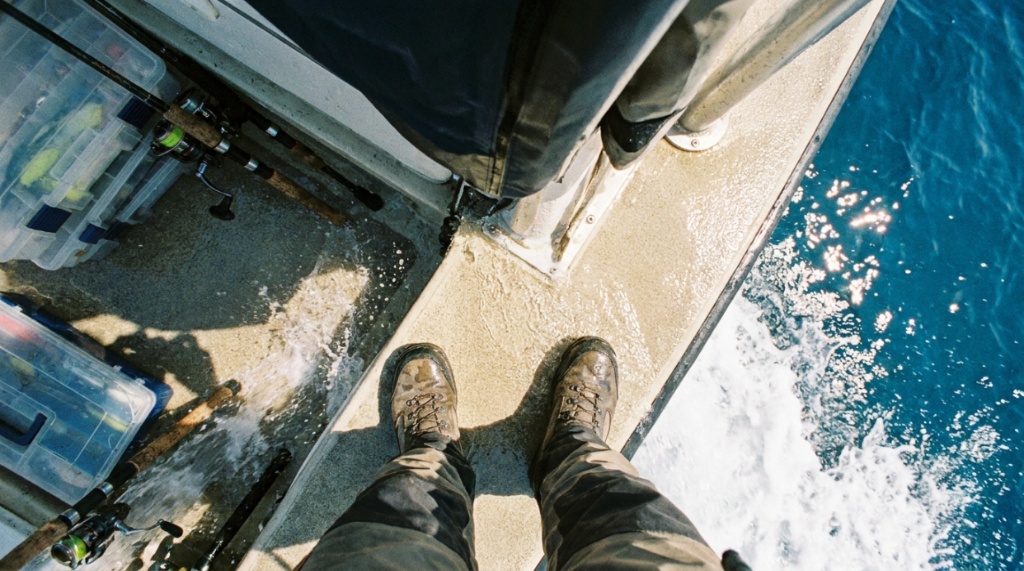
A fishing shoe without proper non-slip grip is just a regular shoe that gets wet — and a regular shoe on a wet boat deck is an injury waiting to happen with statistical certainty. Every great pair of fishing shoes shares seven non-negotiable features that separate purpose-built angling footwear from repurposed outdoor shoes marketed to fishermen. These features — grip technology, drainage engineering, protective construction, comfort systems, secure fit, durable materials, and quick-dry capability — work together as a system where each element supports the others. Fishing shoes are specialized footwear engineered for wet, slippery, and hazardous environments encountered during angling — designed to keep you upright, protected, and comfortable across 6–12 hour days on water. The problem? Marketing teams label generic water shoes as “fishing shoes” after adding drainage holes and a fish logo — without engineering the seven critical performance features that actual anglers need. This guide defines what genuine angler footwear must deliver, how to verify each feature before purchase, and why compromising on any single element creates a cascade of problems across your entire fishing experience.
Feature #1: Non-Slip Outsole With Proper Siping
The non-slip outsole is the single most critical fishing shoe feature — without it, every other feature becomes irrelevant because you’ll be injured on a wet surface before comfort, drainage, or durability matter.
What “non-slip” actually means in fishing context:
- Siping: Razor-thin cuts (1–2mm wide) across rubber tread blocks that create micro-suction channels. When your weight compresses these channels against a wet surface, they evacuate water and create vacuum grip. Count the sipe lines per tread block — 8+ indicates proper engineering, under 5 indicates inadequate wet grip.
- Rubber compound softness: Measured on durometer scale. Fishing-grade rubber rates 50–65 (soft). Standard shoe rubber rates 70–85 (hard). Softer rubber conforms to smooth surfaces at microscopic level, creating molecular adhesion impossible with hard compounds.
- Tread pattern geometry: Multi-directional channels that evacuate water regardless of force direction. Boat movement creates unpredictable forces — your sole needs grip forward, backward, and laterally simultaneously.
- Non-marking formulation: White or light rubber that won’t scuff fiberglass boat decks. Beyond protecting boat surfaces, marking compounds create a lubricating residue that reduces long-term deck traction for everyone aboard.
How to verify: press the sole against wet smooth tile and attempt to slide it. Quality fishing outsoles resist sliding with visible suction effect. Standard outsoles glide freely. This 5-second test eliminates 90% of inadequate shoes immediately.
Feature #2: Effective Water Drainage System
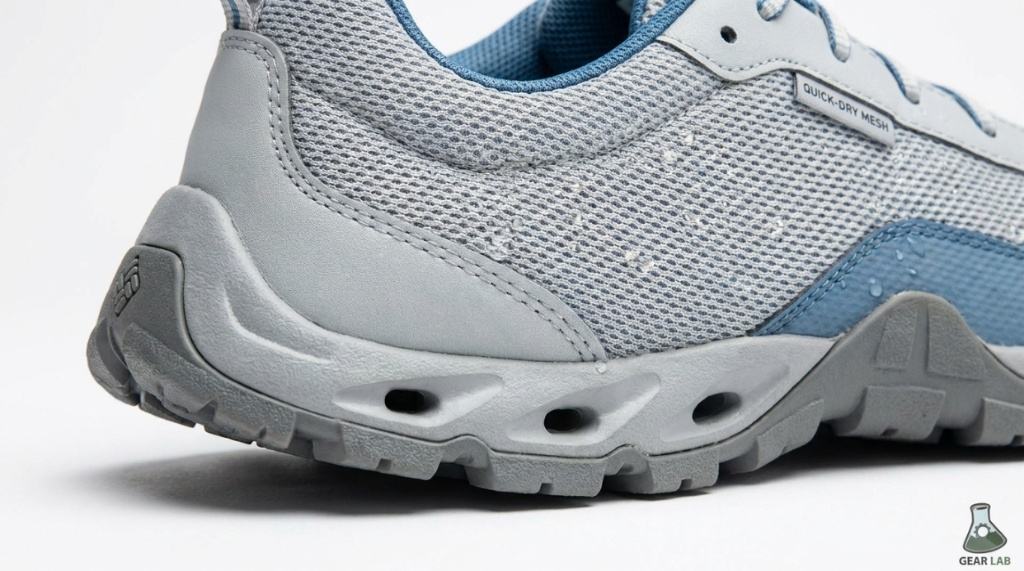
An effective drainage system evacuates water from inside the shoe within 10–30 seconds of entry — preventing the added weight, internal slippage, and discomfort that standing water inside footwear creates during active fishing.
Drainage system components:
- Drainage ports (minimum 4–6): Small openings in the shoe’s lower sidewalls or sole that allow trapped water to escape through gravity and foot pressure. Positioned at the lowest points where water naturally collects.
- Mesh panels: Large ventilation/drainage areas in the upper that allow water to pass through rather than pooling. Faster drainage than ports alone, but sacrifice some structural support and protection.
- Channel midsole: Internal channels between insole and outsole that route water toward drainage ports efficiently. Without channels, water sits in a puddle under your foot until physical force pushes it toward exits.
- Non-absorbent materials: EVA midsoles, synthetic uppers, and quick-dry linings that don’t absorb water themselves. Materials that absorb water defeat drainage systems by holding moisture in the shoe structure rather than releasing it.
Drainage relevance by fishing type:
- Saltwater boat fishing: Critical — deck flooding, spray, and wave wash ensure repeated shoe flooding. Drainage must work efficiently with every cycle.
- Freshwater bank fishing: Moderate — occasional puddles and wet grass. Drainage helpful but less critical than other environments.
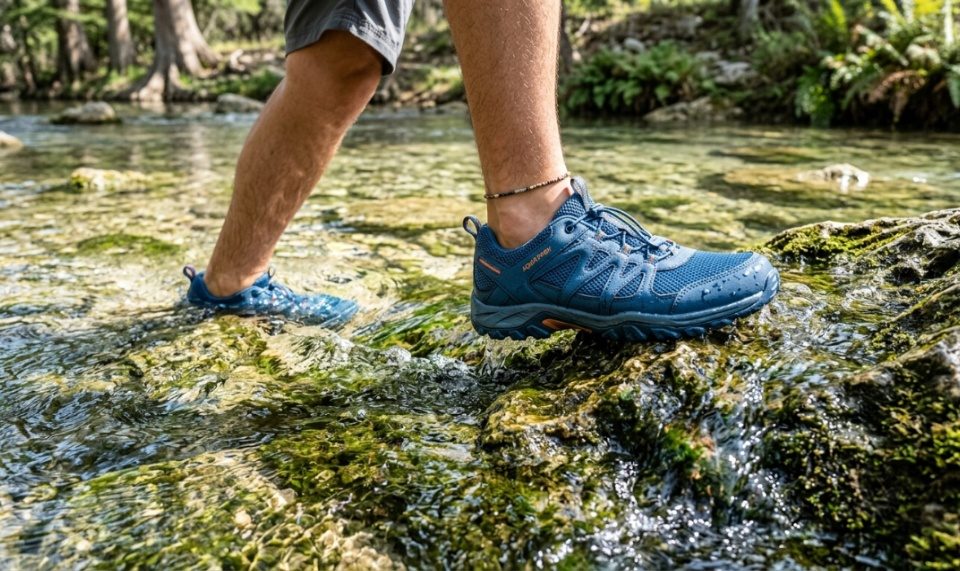
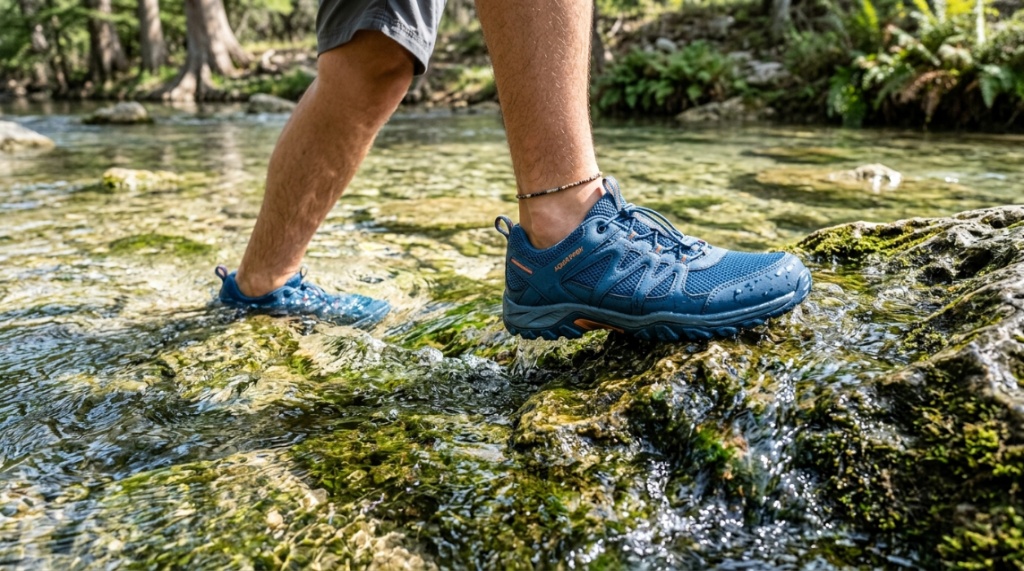
- Wade fishing: Essential — constant submersion requires shoes designed to function while flooded rather than preventing flooding.
Feature #3: Protective Closed-Toe Construction
Closed-toe construction with reinforcement protects against fishing’s most common foot injuries — dropped tackle (sinkers, pliers, knives), stepped-on hooks, kicked equipment, and impact with boat hardware (cleats, rod holders, anchor mechanisms).
Protection elements that fishing shoes require:
- Toe cap (rubber or composite): A reinforced barrier across the front of the shoe that absorbs impact from dropped objects. Doesn’t need to be steel-toe level — but must prevent direct force transfer from a dropped pair of pliers or a 2-oz sinker from reaching your toes.
- Full-coverage upper: No open areas where hooks, fish spines, or sharp equipment can contact skin. This eliminates sandals, open-toe designs, and excessively perforated uppers from consideration for active fishing.
- Thick sole (minimum 10mm): Protection from below — stepping on hooks, treble lures that fell on deck, or fish spines on cleaning surfaces. Thin-soled water shoes provide zero barrier against upward-penetrating hazards.
- Side protection: Shoe sidewalls that resist puncture from lateral contact with hooks hung on rod racks, tackle box edges, and gaff points during active fishing operations.
Injury context: the American College of Emergency Physicians reports that fishing hook puncture wounds, dropped-object foot injuries, and fish spine penetrations rank among the most common fishing-related emergency visits. Closed-toe fishing shoes with adequate sole thickness prevent the majority of these injuries entirely.
Feature #4: All-Day Comfort Systems
All-day comfort requires cushioned midsoles that maintain support after 8+ hours of standing, anatomical arch support that prevents plantar fasciitis, and padding at all contact points that eliminates pressure and friction hotspots.
Comfort systems breakdown:
- Midsole cushioning (EVA or PU): The material between your foot and the outsole that absorbs standing impact. EVA (ethyl vinyl acetate) provides lightweight cushion but compresses over time. PU (polyurethane) provides denser, longer-lasting cushion but adds weight. Either dramatically outperforms thin rubber midsoles for all-day standing.
- Arch support: Built-in or aftermarket insole with contoured arch that distributes standing pressure across the entire foot rather than concentrating it on heel and forefoot. Without arch support, 8-hour standing days reliably trigger plantar fasciitis — a condition that sidelines anglers for weeks.
- Heel cushion/drop: Slight heel elevation (4–8mm drop from heel to toe) reduces Achilles tendon strain during prolonged standing. Zero-drop shoes work for walking but create tendon fatigue during static standing common in boat fishing.
- Padded collar: The fabric/material ring around the ankle opening that contacts your leg. Adequate padding prevents chafing during repetitive ankle flexion (casting, bending, walking on uneven surfaces).
- Seamless interior: Internal seams that contact skin create friction points under wet conditions. Quality fishing shoes position seams externally or cover internal seams with smooth overlays that prevent direct skin contact.
Comfort investment principle: a $30 aftermarket insole (Superfeet Green, Currex RunPro) added to a moderately cushioned fishing shoe often provides better all-day comfort than buying a $50-more-expensive shoe with slightly better built-in cushioning. Prioritize outsole grip and construction quality in the shoe itself, then optimize comfort with replaceable insoles you can upgrade independently.
Feature #5: Secure Fit and Retention System
A secure fit system locks your foot inside the shoe during unpredictable boat movement, aggressive hook-setting motions, and terrain traversal — preventing the internal sliding that causes blisters, ankle rolls, and loss of grip control.
Retention system options:
| System Type | Security Level | Convenience | Wet Performance | Best For |
|---|---|---|---|---|
| Traditional lacing | Excellent (adjustable) | Moderate (tying required) | Laces can loosen when wet | Wade boots, bank fishing shoes |
| BOA dial system | Excellent (micro-adjustable) | Excellent (one-hand tightening) | Maintains tension when wet | Premium fishing shoes |
| Bungee/elastic lacing | Good | Excellent (slip-on with adjustment) | Good — elastic maintains tension | Quick on/off deck shoes |
| Strap/velcro | Moderate | Excellent | Moderate — velcro weakens with salt/sand | Casual fishing sandals |
| Pull-on (no closure) | Moderate (relies on fit alone) | Excellent (fastest on/off) | Good — no components to fail | Rubber deck boots |
Critical fit elements regardless of system:
- Heel lock: The shoe must prevent heel lift during forward motion. A locked heel eliminates rear-foot blisters entirely.
- Midfoot security: The shoe must prevent lateral foot movement inside the shoe. Lateral shift during boat roll creates ankle injury risk.
- Forefoot room: Despite security requirements, toes need wiggle space. Over-tightening the forefoot restricts circulation and causes numbness during all-day wear.
Feature #6: Corrosion-Resistant and Durable Materials
Materials must resist the specific degradation forces in fishing environments — salt corrosion, UV radiation, constant moisture cycling, and mechanical abrasion from terrain and equipment contact — without compromising comfort or weight.
Material requirements for fishing longevity:
- No exposed metal: Any metal component (eyelets, rivets, buckles, hooks) in a saltwater environment will corrode unless made from marine-grade stainless steel or titanium — materials rarely used in footwear due to cost. The safer approach: eliminate metal entirely. Use fabric/molded plastic eyelets, stitched construction instead of rivets, and plastic/nylon hardware.
- UV-stabilized synthetics: Nylon, polyester, and EVA materials treated with UV stabilizers resist the material breakdown (fading, brittleness, cracking) that unprotected materials develop under intense sun exposure. Check for “UV-resistant” or “UV-protected” in material descriptions.
- Bonded/stitched + bonded construction: Sole attachment using both adhesive and stitching (double-secured) resists the delamination that adhesive-only construction experiences when salt solutions attack glue bonds. Look for visible stitching where sole meets upper in addition to glue.
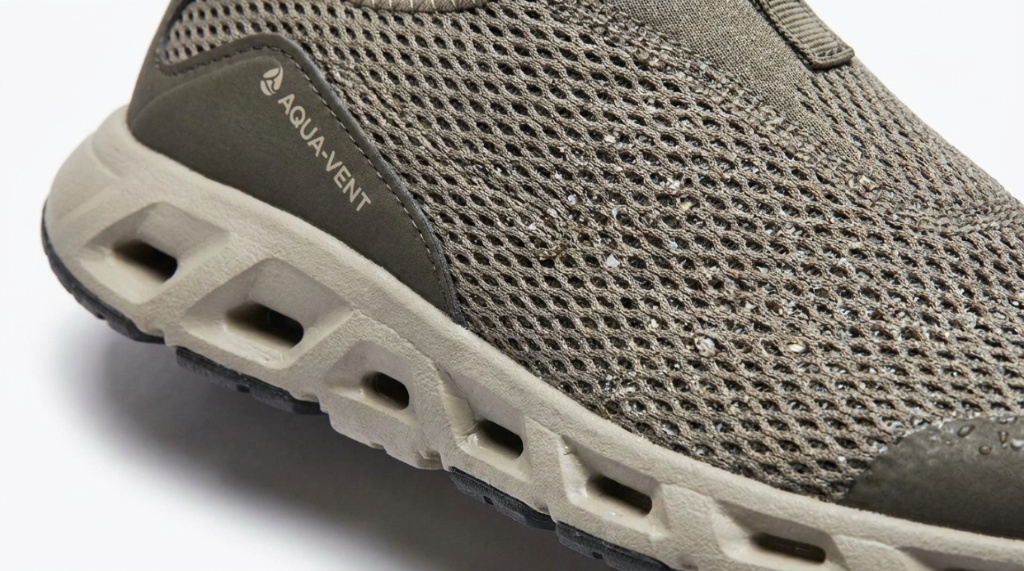
- Quick-dry fabrics: Synthetic mesh that doesn’t absorb water and dries within 30–60 minutes prevents the wet-storage degradation that trapped moisture creates between trips. Avoid shoes with cotton, felt (except dedicated wading felt), or slow-drying materials.
- Abrasion-resistant overlays: Toe, heel, and high-wear zones reinforced with rubber, TPU (thermoplastic polyurethane), or extra material layers that resist the friction damage from boat hardware contact, terrain scraping, and general fishing activity wear.
Feature #7: Quick-Dry and Antimicrobial Properties
Quick-dry capability ensures shoes are ready for the next trip without residual dampness that breeds bacteria — and antimicrobial treatment prevents the inevitable odor and material degradation that warm-moisture environments create inside fishing footwear.
Why these features matter for fishing specifically:
- Drying speed: Fishing shoes get wet repeatedly. Without quick-dry materials, shoes stored damp between trips (even just 24–48 hours) develop mold, mildew, and bacterial colonies that create permanent odor and weaken materials from the inside out. Quick-dry materials (synthetic mesh, EVA, hydrophobic-treated fabrics) shed 90%+ of moisture within 60 minutes of air exposure.
- Antimicrobial treatment: Warm, moist environments inside shoes are ideal bacterial growth media. Antimicrobial-treated insoles and linings (silver ion, zinc pyrithione, or copper-infused materials) actively suppress bacterial colonization — maintaining hygiene and preventing the foot-health issues (fungal infections, bacterial dermatitis) that plague anglers in tropical environments.
Verification methods:
- Drip water onto the shoe’s interior lining. Quick-dry linings bead and run off. Absorbent linings darken and hold moisture.
- Check product specifications for antimicrobial treatment claims — brands using Aegis, Polygiene, or similar treatments typically disclose this explicitly.
- Read reviews specifically mentioning odor after 3+ months of use. Shoes without antimicrobial treatment accumulate a noticeable smell quickly in warm fishing environments.
Getting your gear right is the first step toward a successful trip, especially when you are organizing a getaway for the whole crew. Once you have sorted out the right footwear to keep everyone safe and dry, you can focus on finding the perfect backdrop for your trip. Exploring Family Friendly Fishing Vacation Destinations ensures that both seasoned anglers and beginners have access to calm waters, great catch rates, and comfortable amenities that make for an unforgettable trip.
Conclusion
Great fishing shoes aren’t defined by brand name, price point, or appearance — they’re defined by seven functional features working together as a performance system. Non-slip grip keeps you upright. Drainage manages water. Protection prevents injuries. Comfort extends your day. Secure fit maintains control. Durable materials ensure longevity. Quick-dry properties maintain hygiene between trips. Remove any single element from this system, and the fishing shoe fails its fundamental purpose.
Evaluate every fishing shoe purchase against all seven features. If a shoe excels at six but fails at one — that one failure will define your experience. A comfortable, durable, well-draining shoe that slips on wet decks is useless. A grippy, protective shoe that creates blisters by hour three ruins trips regardless of its other strengths. Demand all seven. Quality angler footwear at the $80–$150 range delivers every feature without requiring luxury-tier investment. Your feet — and your fishing trips — deserve all seven working together.
Frequently Asked Questions
Which single feature is most important in fishing shoes?
Non-slip outsole grip. Every other feature affects comfort, durability, or convenience — but grip directly affects safety. A comfortable shoe that slips can cause serious injury. An uncomfortable shoe that grips keeps you safe while you endure discomfort until trip’s end. If forced to prioritize one feature above all others for fishing footwear, choose grip without hesitation.
Do all seven features exist in shoes under $100?
Yes — brands like Shimano Evair ($70–$90), Huk Rogue Wave ($80–$100), and Grundéns Sea Knit ($90–$110) deliver all seven features at accessible price points. The trade-off at lower prices is typically durability (12–18 month lifespan vs. 24+ months at premium tier) rather than feature absence. All seven features are achievable without premium pricing.
Can fishing shoes double as casual water shoes?
Quality fishing shoes work excellently as general water activity shoes — they offer better grip, drainage, and protection than dedicated water shoes from recreational brands. However, their industrial appearance may not suit casual beach or pool settings aesthetically. Functionally, they outperform generic water shoes in every measurable category.
How do I know when a fishing shoe has lost its effectiveness?
Test grip by pressing the sole against wet tile — if it slides easily where it once resisted, grip is compromised. Check drainage by pouring water in — if it takes longer than 30 seconds to exit, ports are clogged. Inspect toe protection for cracks or thinning. If any of the seven features has degraded below functional minimum, the shoe has lost effectiveness regardless of remaining condition in other areas.
Should I prioritize different features for different fishing types?
Yes. Boat fishing: prioritize grip (#1) and drainage (#2). Bank fishing: prioritize comfort (#4) and materials (#6). Wade fishing: prioritize protection (#3) and secure fit (#5). All fishing types benefit from all seven features — but your dominant fishing activity determines which features earn the most scrutiny during purchase evaluation.
Are fishing boots better than fishing shoes?
Boots provide superior ankle protection and coverage — better for rough conditions, cold water, and offshore fishing. Shoes provide superior breathability, lighter weight, and freedom of movement — better for warm conditions, flats fishing, and long standing days. Neither is universally “better.” Match the height and coverage to your environment: more protection for rougher/colder conditions, more freedom for calmer/warmer conditions.